
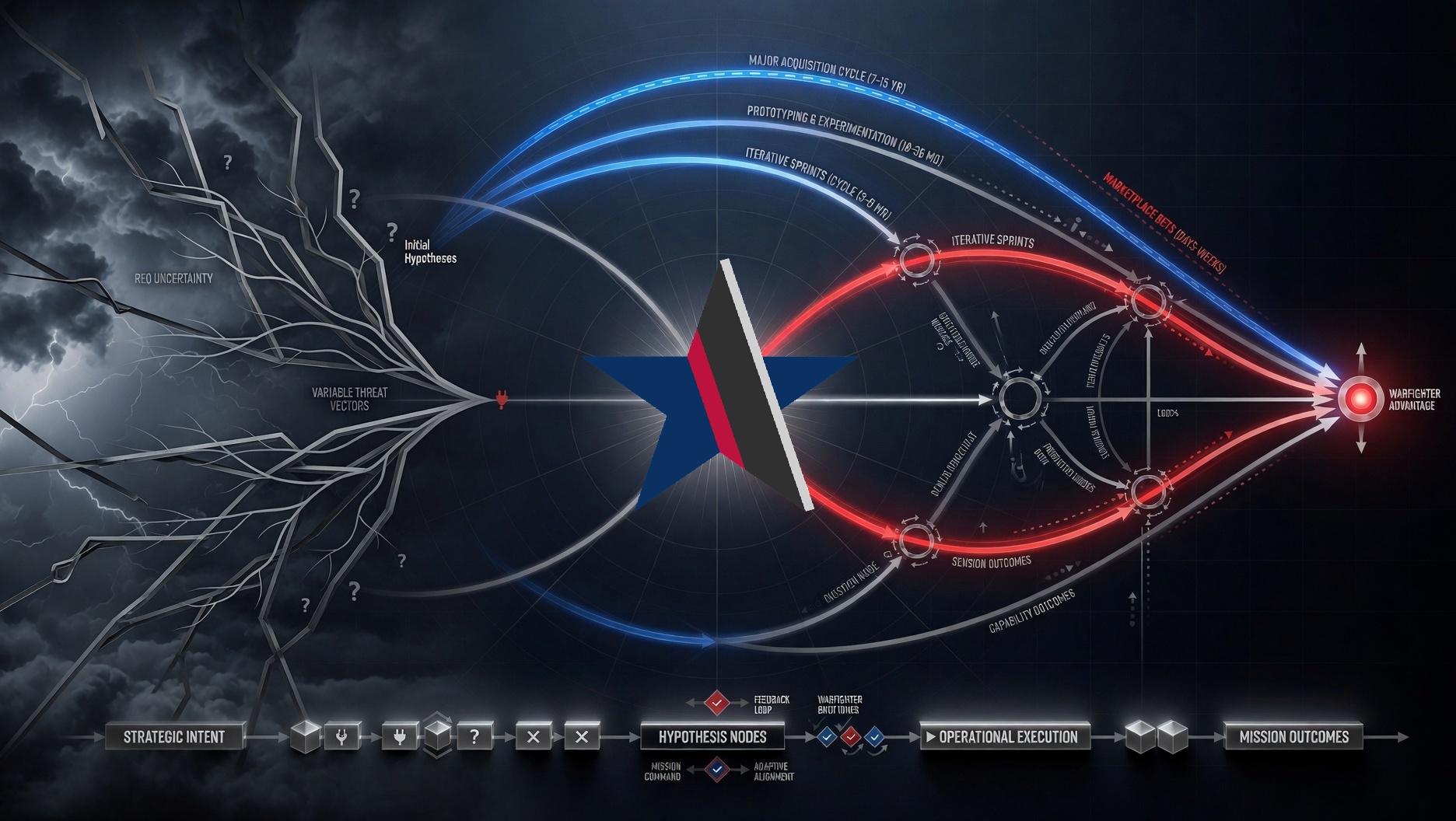
From Requirement Uncertainty to Mission Outcomes
Quick Read
Vision sets the destination. Prediction charts the course. In the world of AI and autonomous systems, where requirements carry high uncertainty and technology evolves rapidly, success depends on forming explicit, testable hypotheses about capability, cost, and schedule and then applying disciplined error correction to stay aligned with the intended outcome.
The Adaptive Acquisition Framework offers a spectrum of pathways calibrated to different prediction horizons: long-range commitments for enduring major systems, medium-term prototyping for rapid fielding, short iterative cycles for software, and near-zero-shot bets through marketplace-style vehicles. Recent JCIDS reforms, the Modular Open Systems Approach, and updated Intellectual Property strategies shift from rigid upfront requirements to focused operational problem statements that free leaders to test assumptions at the speed of relevance.
Ready to go deeper? Continue below for historical context, organizational insights, and practical reflections.
Deeper Dive (10 minutes)
The Range of Uncertainty
Defense acquisition has always required leaders to make forward-leaning bets under uncertainty. The Adaptive Acquisition Framework recognizes this by offering a calibrated spectrum of pathways. Major Capability Acquisition supports enduring, large-scale systems with predictions extending years or decades. Middle Tier Acquisition shortens the horizon to roughly five years for rapid prototyping or fielding of mature technologies. The Software Acquisition Pathway compresses the timeline into months-long iterative cycles. Marketplace-style procurements such as Commercial Solutions Openings enable near-zero-shot predictions with minimal upfront documentation paired with immediate feedback loops.
Recent announcements show how leaders can place directional bets and let operational data drive course correction. For instance, the 2025 Acquisition Transformation Strategy has accelerated UAS and c-UAS marketplace vehicles to move from experimentation to rapid fielding against evolving threats. Uncertainty is no longer a barrier; it becomes the mechanism that drives innovation.
Lessons That Shaped the Modern Framework
This spectrum did not emerge in a vacuum. Ambitious programs such as Future Combat Systems revealed the limitations of rigid, long-horizon assumptions when applied to low-maturity technologies. Attempts to lock in an entire system-of-systems architecture early created a straitjacket that constrained innovation and made adaptation difficult as real-world conditions evolved. These experiences, explicitly cited in the 2025 Acquisition Transformation Strategy, underscored a fundamental truth that when requirements carry high uncertainty, overly prescriptive planning can stall progress rather than enable it.
In response, the Department of War undertook a deliberate realignment. The Adaptive Acquisition Framework was joined by the Modular Open Systems Approach, which mandates open architectures so new technologies can be inserted rapidly without redesigning entire platforms. Complementary Intellectual Property reforms clarified data rights and commercial-friendly terms, encouraging industry innovation while protecting the government’s ability to evolve capabilities over time. The Department of War has moved from trying to eliminate uncertainty through exhaustive planning to managing it through disciplined, adaptive processes that respect the pace of innovation.
From Operations Research to Startup Culture
The intellectual foundation for these reforms stretches across decades of organizational learning. During World War II, Operations Research teams pioneered structured predictive feedback loops to optimize complex systems under battlefield uncertainty. The Toyota Way refined this into the Plan-Do-Check-Act (PDCA) cycle, a disciplined methodology of explicit hypothesis testing, rapid error correction, and steady cadence suited to relatively stable environments and incremental quality improvement that grew from defense organizational research. Modern agile approaches, drawing more from OODA-loop principles of rapid observation, orientation, and tempo in dynamic uncertainty, extended these ideas through minimum viable products and learning loops.
Plan-Prepare-Execute-Assess (PPEA) serves as both doctrinal foundation and the essential framework of Major Capability Acquisition, providing a structured yet adaptive frame for long-horizon programs. In today’s Department of War, these elements are applied as a deliberate hybrid. PDCA-style process discipline appears inside the Software Acquisition Pathway’s DevSecOps Reference Design (updated 2025), while OODA-like agility supports iterative experimentation using marketplace as an enduring mechanism pioneered under programs such as Replicator and Collaborative Combat Aircraft. Predictive feedback loops are well-structured methodologies, not ad hoc reactions. They treat iteration, not the traditional lifecycle, as the essential frame of reference. Repetition builds mastery while continuous correction keeps the trajectory aligned even when the full path cannot be predicted. Tailoring the approach is the pathway to success — adopting proven principles into acquisition practice allows leaders to test assumptions incrementally and maintain forward momentum in environments of high uncertainty.
Requirements Uncertainty and the JCIDS Transformation
For decades, the Joint Capabilities Integration and Development System framed predictions through detailed capability documents and joint validation. Its deliberate nature provided stability but often slowed adaptation when innovation moved faster than documentation. The 2025 reforms fundamentally changed this dynamic. JCIDS has been largely disestablished for most programs, with the Joint Requirements Oversight Council shifting focus to identifying and ranking a concise set of Key Operational Problems rather than validating exhaustive Service-level requirements. Services now own their requirements processes to a far greater degree. The result is a leaner mechanism: clear problem statements paired with flexible pathways that allow hypotheses to be tested and refined without waiting for perfect certainty.
While the reform is profound, Services are still maturing internal processes in 2026 to fully exercise this ownership. When requirements are inherently uncertain because the technology itself is still evolving, leaders can frame directional hypotheses, test them against real-world data, and correct course incrementally. The workforce experiences less disruptive churn and more sustainable cadence. The reform is not merely procedural; it is a cultural acknowledgment that prediction in an innovation-driven era must be active and iterative rather than static and exhaustive.
The Power of Disciplined Pivots and Alignment
Modern agile approaches embedded in the Software Acquisition Pathway and DoD DevSecOps practices demonstrate the power of pivoting without destructive churn. The “fail fast, fail forward” ethos, which tests small, explicit hypotheses through minimum viable products and rapid learning cycles, allows teams to surface flawed assumptions early, absorb the lesson at minimal cost, and redirect resources cleanly. This disciplined agility preserves cadence. Repetition builds mastery while the ability to pivot keeps the trajectory aligned with evolving realities. However, unstructured pivots in experimentation-driven marketplaces carry real risk. They can lose the constructive iteration needed for true requirement discovery and capability maturation. Even under the new framework, clean pivots remain tested by reprogramming limits, congressional oversight, and industrial-base dependencies. This is precisely why disciplined hypothesis-tracking is essential.
Yet the greatest test of prediction lies in aligning tempo across the entire value chain, from industry suppliers and prime contractors through policy stakeholders to the soldier in the formation. The AAF and its accelerated pathways demand faster decision cycles, modular contracting, and continuous feedback. Industry partners must recalibrate to rapid prototyping. Oversight bodies must navigate new risk tolerances. Soldiers provide the operational truth that validates every hypothesis. Policy challenges, including legacy incentives, compliance burdens, cultural caution, PPBE cycles, and audit culture, can lag the new tempo. Successful programs overcome this by forging shared rhythm: clear problem statements that cascade downward, transparent data that flows upward, and deliberate synchronization that keeps the entire chain moving as one adaptive system. Prediction is not only a planning discipline. It is a leadership practice that must synchronize the full human and industrial platform if innovation is to translate into enduring mission outcomes.
Accountability for Enduring Advantage
Effective prediction in this environment demands leadership that balances decisive direction with the humility to revise when evidence demands it. It requires making assumptions visible, prototyping them rigorously, and applying steady error correction across strategic, operational, and tactical loops. Even the most complex transformation trajectories become manageable when broken into linear segments that can be tracked and adjusted.
In an era of rapid technological change, the organizations that gain lasting advantage are those that treat prediction as an active leadership practice. They make testable bets calibrated to the pathway at hand, apply continuous error correction, and keep the entire value chain aligned. The result is not perfect foresight, but measured progress that delivers mission outcomes at the speed of relevance.
Mission Command in the Enterprise – Acquire How We Fight
This alignment of prediction and error correction is not accidental. It mirrors the fundamental philosophy that already defines how the United States armed forces fight: mission command. Doctrine in JP 3-0 is clear that commanders issue clear intent and then empower those closest to the point of action to exercise disciplined initiative. The power lies in “making decisions in the dirt,” where real conditions, not distant plans, shape outcomes. Effective leaders don’t have the best crystal ball, they effectively navigate to the outcome amid the chaos of real conditions.
The acquisition enterprise is deliberately adopting the same philosophy. Key Operational Problems (KOPs) now serve as the enterprise-level commander’s intent. Leaders closest to the operational reality, the program manager negotiating the forward cost of a prototype, the formation providing soldier feedback, the contracting officer negotiating data rights that align industry and government success, they are the ones who must be empowered to make rapid, evidence-based pivots. Just as contracting and competition methodologies have been realigned through MOSA, updated Intellectual Property strategies, and marketplace vehicles to unlock innovation from industry, the broader acquisition value chain is being realigned to unlock speed and adaptability from those nearest the fight.
This is not a claim that acquisition is the same as a combatant command. It is a coherent enterprise position: the Department of War fights with mission command and is served well to conduct acquisitions with mission command at the scale and complexity of the operations required. When prediction is treated as an active leadership practice with testable hypotheses, disciplined error correction, and synchronized rhythm across the full human and industrial platform, the acquisition enterprise becomes a true extension of the operational force rather than a separate bureaucracy. The result is deeper alignment between how we fight and how we prepare to fight, ensuring that technological superiority translates into enduring warfighting advantage.
Closing Reflection
- Where in your program have explicit, testable hypotheses and steady error correction helped maintain momentum amid high requirements uncertainty?
- What one assumption might benefit from being framed more clearly as a hypothesis and tracked incrementally across the appropriate acquisition pathway?
- How effectively is your program synchronizing rhythm across the full value chain, from industry suppliers and oversight bodies to the soldier providing operational feedback?
- In what ways could mission-command principles, such as clear Key Operational Problems and empowered pivots at the point of action, strengthen decision-making in your chosen acquisition pathway?
- Where might unstructured pivots in experimentation-driven marketplaces risk losing constructive requirement discovery and capability maturation, and how could deliberate adoption of proven frameworks like PPEA, PDCA, or OODA loops restore disciplined progress?
These shared reflections sharpen our collective foresight. Systems Intelligence thrives when people, policy, and technology move forward with shared confidence and adaptive discipline.
© 2026 Previsyn. The Systems Intelligence Company. All rights reserved.