
From Stakeholder Chaos to Principled Collaboration
Quick Read
The Department of War continues its decisive advance toward an AI-first force, guided by clear strategic direction and disciplined forward-leaning bets. Yet senior leaders point to a persistent friction that can quietly erode momentum: the complex web of interdependencies across programs, technologies, stakeholders, and evolving discoveries. In this environment, communication and action must stay aligned even as new realities emerge daily.
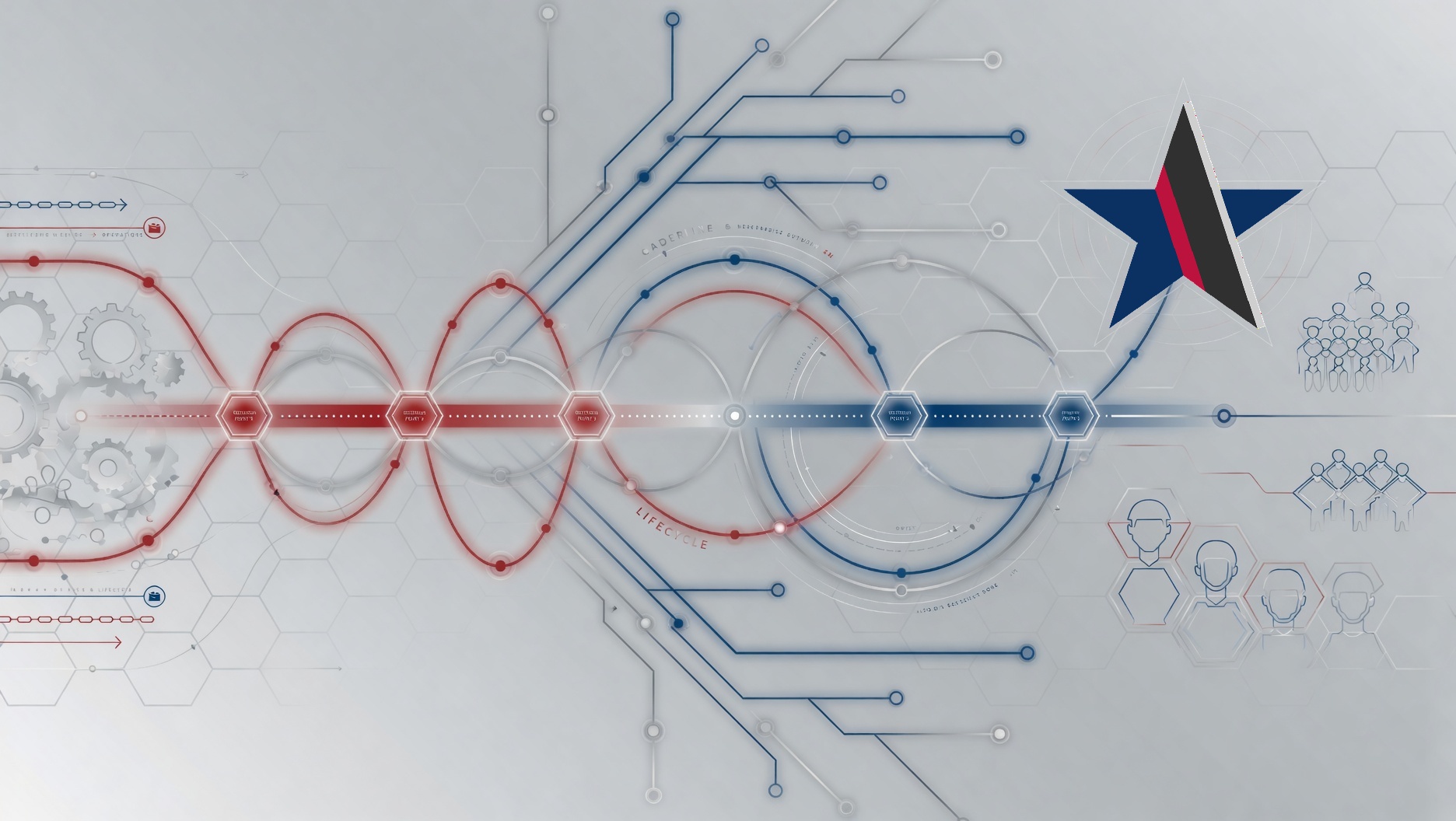
Cadence and lifecycle stand as the two foundational frameworks that make synchronization possible, connected by event-driven mechanisms that enable context-switching across strategic, operational, and tactical levels. When deliberately balanced between these frameworks, synchronization shifts from a source of friction and communication overhead to the essential organizational function that converts complexity into measured progress. Synchronization aligns the vision to the reality that enables the predictive practices to set the enterprise on course.
Ready to go deeper? Continue below for historical context, organizational insights, and practical reflections.
Deeper Dive (10 minutes)
The Web of Interdependencies
Defense acquisition has always operated in a landscape of overlapping demands. Programs must integrate maturing technologies, respond to shifting operational needs, coordinate across services and industry, and deliver capabilities while discovery continues at every level. When these interdependencies fall out of rhythm, even well-resourced initiatives encounter cascading delays, duplicated effort, and stalled adaptation. The result is not simply slower progress but a fundamental impedance that can undermine the very transformation the Department seeks.
Current Department-wide transformation efforts further underscore that synchronization is not optional; it is the principle that determines whether interdependencies become friction or fuel. Yet some transformation efforts risk isolating specific functions or organizations rather than synchronizing them across the enterprise. When pieces are bypassed instead of being fully transformed as part of the whole, the challenge of reintegrating those functions will realize the truth, that the transformation itself was not accomplished.
When cadence falters and the power of predictive iteration is not respected, the organization can experience operational chaos, workforce churn, and even mission failures as teams lose shared rhythm and discovery goes unaddressed. Without the steady iteration that builds mastery, the workforce and broader enterprise have little opportunity to become more effective amid the distractions and shifting priorities that desynchronization creates. When lifecycle externalities are not respected, the consequences appear in missed schedules, budget overruns, and performance gaps that erode confidence across the enterprise. These are the real, measurable costs of desynchronized action.
History offers clear perspective on this dynamic. The Packard Commission and Goldwater-Nichols reforms of the mid-1980s sought to impose greater coherence on fragmented service programs through stronger central oversight and jointness. While they advanced joint operations and acquisition discipline, they also highlighted how service-centric development rhythms often remain out of phase with broader interdependencies. Similarly, Nunn-McCurdy unit-cost breach mechanisms, enacted to spotlight cost growth, have repeatedly illustrated the consequences of misaligned timelines between technology readiness, funding cycles, and operational requirements. In wartime, by contrast, urgency compresses these rhythms into rapid, repeated synchronization points—producing battlefield innovations at speeds peacetime bureaucracy rarely matches.
Events as the Bridge Across Levels
The practical mechanism that connects cadence and lifecycle is event-driven decision-making. These events—milestone reviews, experimental assessments, or emergent triggers—act as context switches that detect new information at one level and propagate alignment across the hierarchy. An emerging tactical discovery, such as a new operational approach, can initiate its own lifecycle while triggering cadence-driven adjustments at the operational level and strategic portfolio rebalancing — helping synchronize activity from industry partners through the formation in the field.
This hierarchical interplay of iterations and loops allows the enduring organization to absorb multiple, heterogeneous external arcs without losing coherence. Events do not replace cadence or lifecycle; they ensure the two remain synchronized, turning potential friction into disciplined adaptation at every scale. However, the failure to causally link a cadence, such as the soon-to-end Project Convergence series, with deliberate synchronization to decision points and other events in the heterogenous lifecycle of programs it sought to inform, failed to deliver the desired transformation.
Cadence as the Rhythm of Discovery
Within the enduring structure of the Department of War, cadence functions as the predictable heartbeat that turns discovery from disruption into disciplined input. It establishes regular, rhythmic points for communication and action—whether through iterative capability releases, program increments, or continuous integration events. This rhythm does not eliminate uncertainty; it creates the reliable intervals at which stakeholders can share emerging insights, test assumptions, and adjust without derailing the larger enterprise.
In practice, cadence allows organizations to absorb the heterogeneous lifecycles of external elements while maintaining internal coherence, such as technologies that mature at different speeds, missions that evolve unpredictably, and innovations that arrive in waves. When aligned properly, it surfaces interdependencies early, reduces the transaction costs of coordination, and builds organic capacity through repetition. The organization remains stable yet responsive, able to act on real-time learning without sacrificing strategic direction.
Lifecycle as an Essential Scaffold
Complementing cadence is the classic lifecycle framework that has long governed major acquisition. Milestone-based phases provide governance, risk reduction, accountability, and long-term sustainment for high-consequence capabilities. This scaffold ensures that maturing systems receive the structured maturation they require, protecting against premature commitments and preserving hard-won lessons from prior generations.
Yet when lifecycle operates in isolation from or in the absence of organizational cadence, it becomes rigid, unable to incorporate rapid discoveries or respond to shifting interdependencies. Both viewpoints are essential: how do varied lifecycles align to the cadence of the organization and how does the cadence align to the lifecycle of key externalities. The essential insight is complementarity: cadence supplies the stable platform for innovation, while lifecycle supplies the stable platform for maturation, keeping the vision alive to external realities with the linkage of critical events. Together they enable the organization to manage synchronization at scale across disparate efforts, simultaneously and without losing focus or coherence.
Pathways, Enablers, and the Power of Balance
Recent policy evolution demonstrates how this balance can be operationalized. The Adaptive Acquisition Framework introduced tailored pathways that explicitly recognize different rhythms—structured governance for enduring systems alongside faster cycles for software and prototyping.
A particularly instructive example is the Department’s push for a Modular Open Systems Approach. MOSA is designed to accelerate innovation and competition through open, modular interfaces. These interfaces allow rapid insertion of new capabilities. Yet its implementation reveals the real-world tension. Without strong synchronization supporting both innovation and standardization (the “gold standard” of maturation) across varying lifecycles, the demand for interoperability merely slows progress and prevents valuable outcomes for either. This dynamic plays out across the full value chain from industry suppliers developing compliant modules to the warfighter in the formation. It also spans the full range of operational, organizational, training, equipment, personnel, infrastructure, and policy factors where materiel openness must align with training on common interfaces, logistics for easier sustainment, and policy for joint interoperability. When deliberately synchronized, it demonstrates how the organization can convert potential impedance into measurable efficiency.
Synchronization as Organizational Principle
The quiet power of this balance lies in its ability to turn the Department’s legacy strengths—its scale, its people, its industrial base—into a conduit for enduring transformation. Cadence keeps communication and action flowing at the speed of relevance. Lifecycle ensures that progress remains grounded in accountability and long-term value. When these frameworks are synchronized with the clear destination the enterprise has set and the predictive practices it employs, the result is not faster chaos but measured, resilient advancement.
Synchronization also plays a vital role in aligning industry investment cycles with defense budget realities. By maintaining predictable rhythms and disciplined event-driven handoffs, the enterprise helps industry plan and commit resources with confidence. This preserves capacity and flexibility for unexpected events. In this way, synchronization fundamentally shapes the efficiency with which the organization converts direction into sustained outcomes. Organizations that master this dynamic build the organic capacity to adapt without losing identity, honoring prior competence while shaping the competence required for tomorrow.
Closing Reflection
- Where in your program are interdependencies currently creating friction, and how might clearer event-driven alignment across strategic, operational, and tactical levels or along the full value chain reduce that impedance?
- What one rhythm planning review, integration event, or feedback loop could be strengthened to improve synchronization across your value chain?
- How effectively does your lifecycle governance currently incorporate the cadence of discovery from external technologies or missions?
- In what ways could digital engineering or communications that build shared understanding enhance visibility and action across interdependent elements and the full range of operational, organizational, training, infrastructure, and policy factors in your formation?
- Where might your program already be demonstrating the complementary power of cadence, lifecycle, and event-driven mechanisms and how could that success be scaled to strengthen broader enterprise alignment?
These shared reflections sharpen our collective ability to act as one. Systems Intelligence thrives when cadence and lifecycle work in harmony, enabling people, policy, and technology to move forward with shared rhythm and enduring purpose.
© 2026 Previsyn. The Systems Intelligence Company. All rights reserved.